Acromyrmex heyeri
(Acromyrmex heyeri)
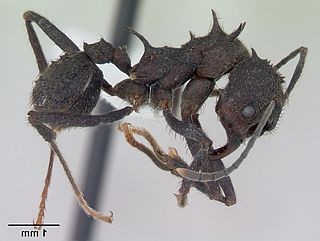
Description
Acromyrmex heyeri is a species of leaf-cutter ant, a New World ant of the subfamily Myrmicinae of the genus Acromyrmex. This species is found in Paraguay, Argentina, Brazil, and Uruguay. Acromyrmex heyeri workers construct the colonies nest by thatching together cut grass. At temperatures ranging from 20–30 °C, workers created more openings in the nest thatch as the internal nest temperature goes up as a method of temperature regulation for the colony. The workers will close openings in the nest thatch as the air humidity surrounding the nest decreases to reduce water loss for the colony. Studies using isoenzyme systems MDH, a-GPDH, and AMY show the occurrence of monogyny and polygyny associated or not with polyandry, which indicates that the social organization is colony-specific. The polygyny and polyandry observed are likely to be responsible for the great genotypic diversity of the species colonies. The average inbreeding coefficient per colony is higher in Acromyrmex striatus than in Acromyrmex heyeri, which may reflect the different patterns of production of sexual individuals and nuptial flight of those two species. Acromyrmex is a genus of New World ants of the subfamily Myrmicinae. This genus is found in South America and parts of Central America and the Caribbean Islands, and contains 33 known species. Commonly known as "leafcutter ants" they comprise one of the two genera of advanced attines within the tribe Attini, along with Atta. Acromyrmex species' hard outer covering, the exoskeleton or cuticle, functions as armour, protection against dangerous solar waves, an attachment base for internal muscles, and to prevent water loss. It is divided into three main parts; the head, thorax, and abdomen. A small segment between the thorax and abdomen, the petiole, is split into two nodes in Acromyrmex species. The antennae are the most important sense organs Acromyrmex species possess, and are jointed so the ant can extend them forward to investigate an object. It can retract them back over its head when in a dangerous situation, for example, a fight. Acromyrmex species have eyes, but their eyesight is very poor. Like all insects, the eye is compound, meaning it is made up of many eyelets called ommatidia, with the number of these eyelets varying according to species. Male ants tend to have more ommatadia than other castes.
Taxonomic tree: