Asota plana
(Asota plana)
Description
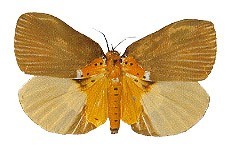
Asota plana is a moth in the family Erebidae first described by Francis Walker in 1854. It is found from the Oriental tropics east to New Guinea. The wingspan is about 56 mm. The forewings have a large white patch filling the lower half of the cell and the whole area below except inner margin and extending to near outer margin. Its upper edge has two dentitions, its outer edge is irregular and a large white spot at upper angle of cell. Hindwings with the narrow marginal band. There is an extra spot towards anal angle. Larva have a large head with sparsely distributed hairs on its body with dark purplish-brown ground color. The thoracic somites are pale red and there is a narrow transverse yellow band on fourth to terminal somites. Larvae have been recorded on Ficus species, where they rest on the underside of the leaf. Asota is a genus of moths in the family Erebidae first described by Jacob Hübner in 1819. Species are widely distributed throughout Africa, India, Sri Lanka, Myanmar, the Malayan region and tropical parts of the Australian region. Palpi upturned, where the second joint reaching the vertex of the head and the third joint is slender in variable lengths. Antennae fasciculated (bundled) in males and ciliated (hairy) in females. Forewings with vein 5 from the lower angle of cell or just above it. Vein 6 from the upper angle or below it. Areole absent. Hindwings with vein 5 from just above lower angle of cell. Veins 6 and 7 from the upper angle. The genus was formerly placed in the families Noctuidae and Arctiidae by some authors. Other authors placed them in the family Aganaidae or Hypsidae. Recent phylogenetic studies have shown that the Aganainae are most closely related to the Herminiinae (litter moths), and this pair of subfamilies is most closely related to the Arctiinae (tiger and lichen moths), all within the family Erebidae.
Taxonomic tree: