European hornet
(Vespa crabro)
Description
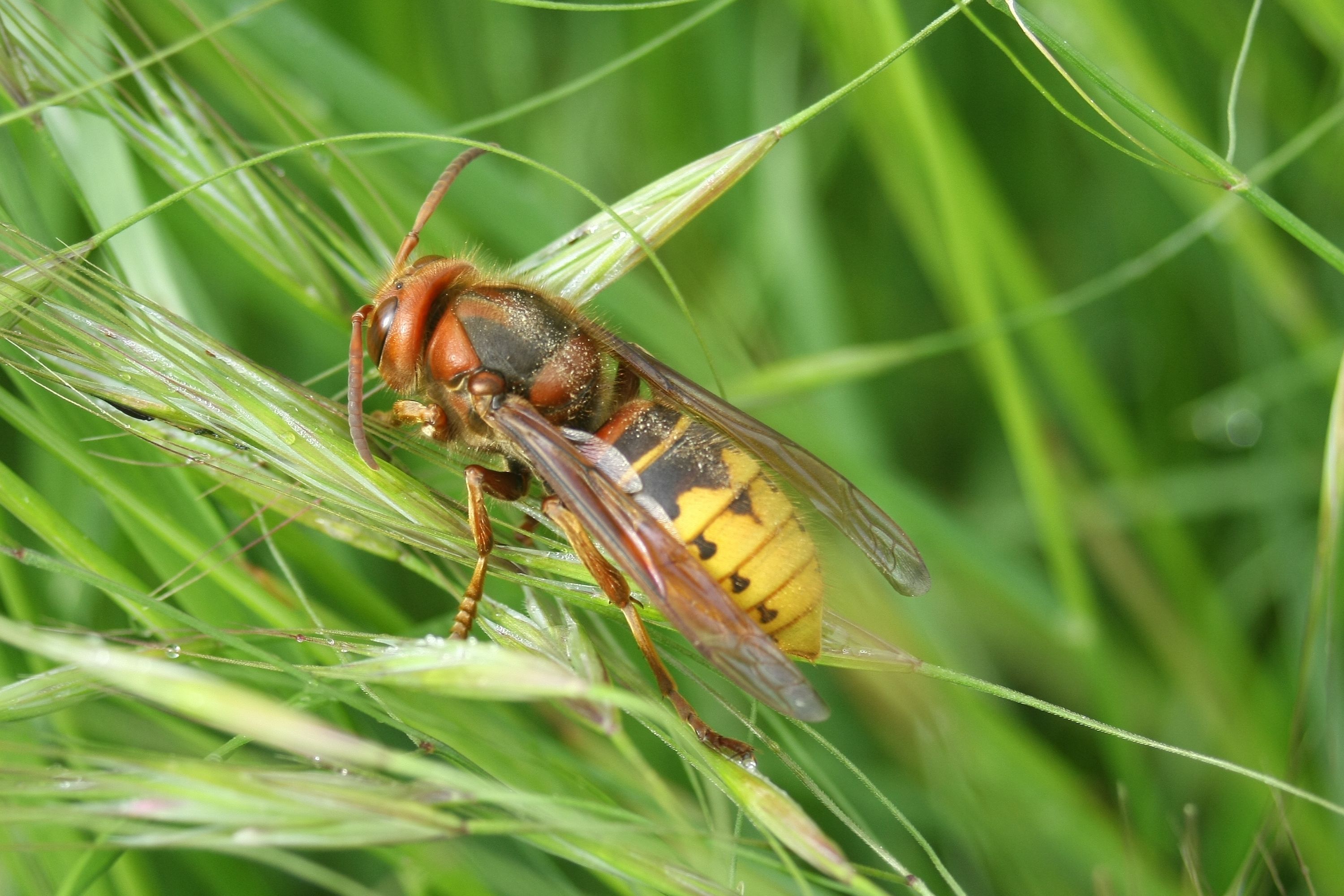
The European hornet (Vespa crabro) is the largest eusocial wasp native to Europe. It is also the only true hornet (genus Vespa) found in North America, having been introduced by European settlers in the 1800s.V. crabro is usually regarded as a pest by those humans who come into contact with it. Vespines, such as V. crabro, are known for making intricate paper-like nests out of surrounding plant materials and other fibers. Unlike most other vespines, reproductive suppression involves worker policing instead of queen pheromone control, as was previously thought. This species stings in response to being stepped on or grabbed, but generally avoids conflict. It is also defensive of its nest and can be aggressive around food sources. Care should be taken when they are found in these circumstances, as they may sting without warning. European hornets are largely carnivorous and hunt large insects such as beetles, wasps, large moths, dragonflies, and mantises.They also feed on fallen fruit and other sources of sugary food.Mutual predation between medium-sized hornets and the Asilidae (robber flies) is often reported. The eyes of V. crabro are deeply indented and shaped like a "C". Its wings are reddish-orange, while the petiolate abdomen is striped with brown and yellow. It has hair on the thorax and abdomen, although the European hornet is not as hairy as most bees. Due to this coloration and abdomen pattern, V. crabro is often mistaken for the Asian giant hornet. Typical mass size for the European Hornet is 477.5±59.9 mg. Workers average around 25 mm (1.0 in) in length, while the larger queens can reach up to 35 mm (1.4 in).This is significantly larger than most common wasps (such as Vespula vulgaris), but smaller than the Asian giant hornet. Females are typically larger than males in both size and mass. However, male abdomens have seven segments, whereas female abdomens have six. There is a cerebral ganglion, two thoracic ganglia, and five abdominal ganglia.Only females possess a stinger; males cannot sting. The antennae of males are slightly longer, with 13 segments compared to twelve segments in females.
Taxonomic tree: