Aardwolf
(Proteles cristata)
Description
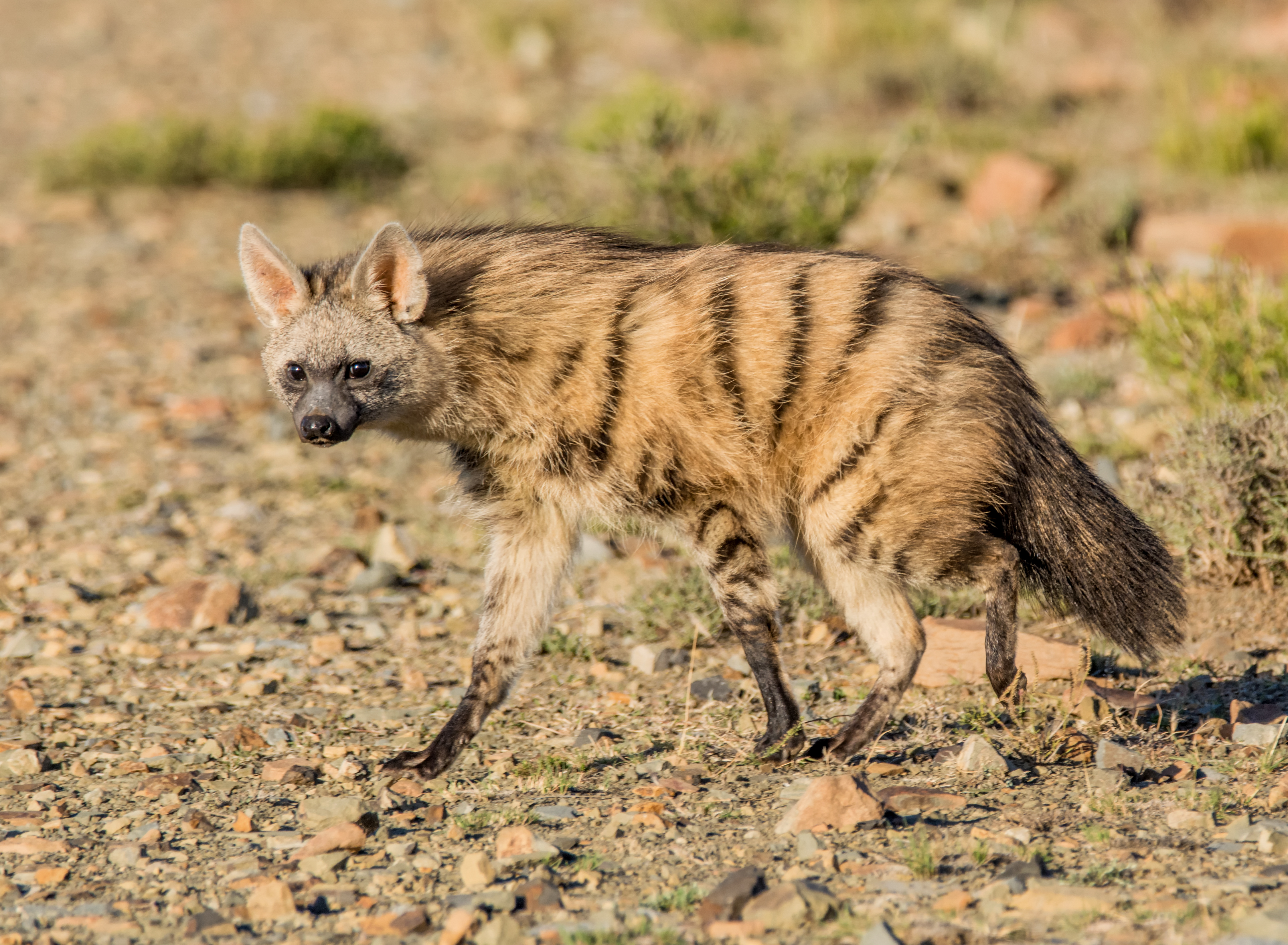
The aardwolf (Proteles cristata) is an insectivorous mammal in the family Hyaenidae, native to East and Southern Africa. Its name means "earth-wolf" in Afrikaans and Dutch. It is also called maanhaar-jackal (Afrikaans for "mane-jackal"), termite-eating hyena and civet hyena, based on its habit of secreting substances from its anal gland, a characteristic shared with the African civet. Unlike many of its relatives in the order Carnivora, the aardwolf does not hunt large animals. It eats insects and their larvae, mainly termites; one aardwolf can lap up as many as 250,000 termites during a single night using its long, sticky tongue. The aardwolf's tongue has adapted to be tough enough to withstand the strong bite of termites. The aardwolf lives in the shrublands of eastern and southern Africa – open lands covered with stunted trees and shrubs. It is nocturnal, resting in burrows during the day and emerging at night to seek food. The aardwolf resembles a very thin striped hyena, but with a more slender muzzle, black vertical stripes on a coat of yellowish fur, and a long, distinct mane down the midline of the neck and back. It also has one or two diagonal stripes down the fore- and hind-quarters, along with several stripes on its legs. The mane is raised during confrontations to make the aardwolf appear larger. It is missing the throat spot that others in the family have. Its lower leg (from the knee down) is all black, and its tail is bushy with a black tip. The aardwolf is about 55 to 80 cm (22 to 31 in) long, excluding its bushy tail, which is about 20–30 cm (7.9–11.8 in) long, and stands about 40 to 50 cm (16 to 20 in) tall at the shoulders. An adult aardwolf weighs approximately 7–10 kg (15–22 lb), sometimes reaching 15 kg (33 lb). The aardwolves in the south of the continent tend to be smaller (about 10 kg (22 lb)) than the eastern version (around 14 kg (31 lb)). This makes the aardwolf, the smallest extant member of the Hyaenidae family. The front feet have five toes each, unlike the four-toed hyena. The teeth and skull are similar to those of other hyenas, though smaller, and its cheek teeth are specialised for eating insects. It does still have canines, but, unlike other hyenas, these teeth are used primarily for fighting and defense. Its ears, which are large, are very similar to those of the striped hyena.
Taxonomic tree: