Budgerigar
(Melopsittacus undulatus)
Description
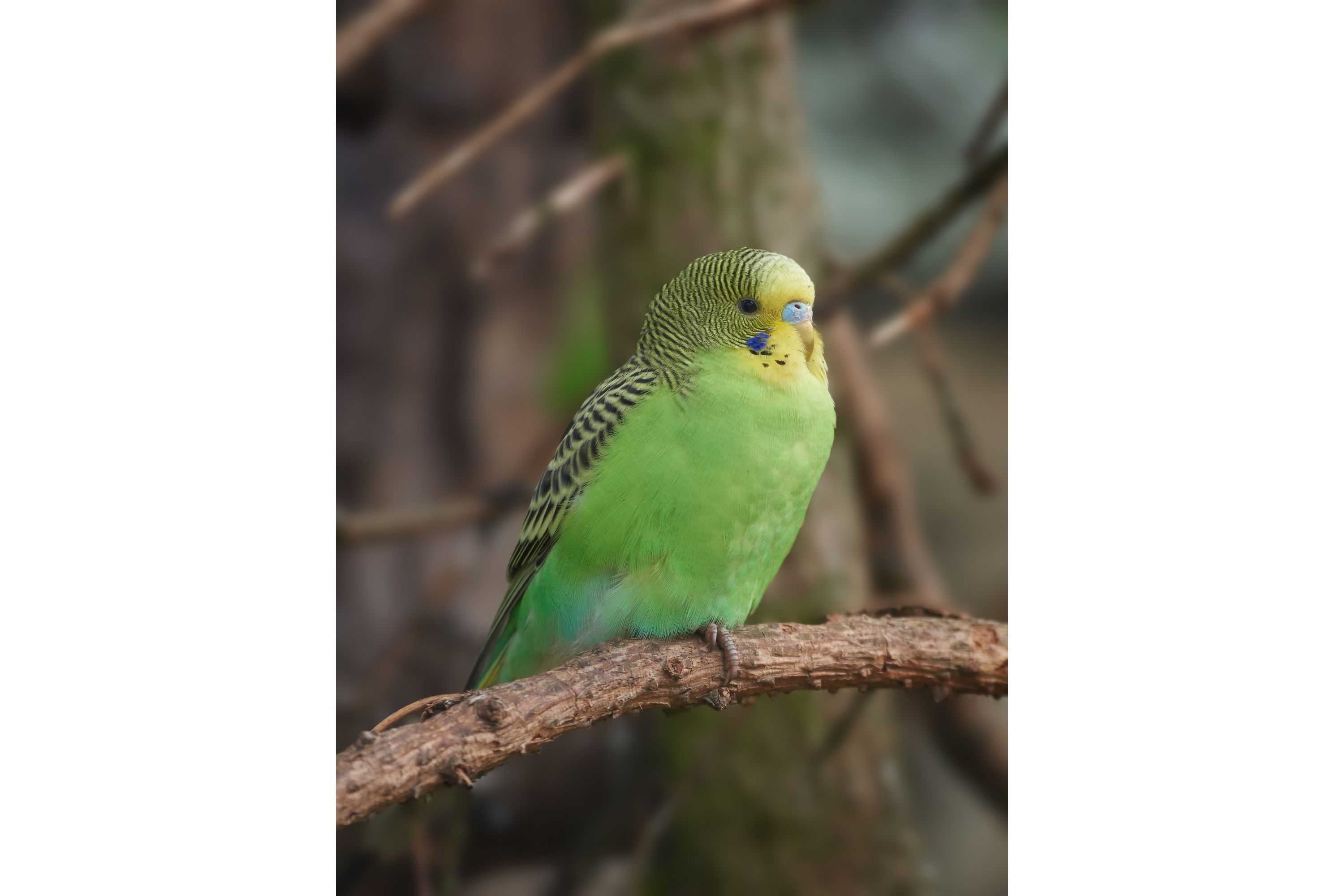
The budgerigar (Melopsittacus undulatus), also known as the common parakeet or shell parakeet, is a small, long-tailed, seed-eating parrot usually nicknamed the budgie or in American English, the parakeet. Budgies are the only species in the genus Melopsittacus. Naturally, the species is green and yellow with black, scalloped markings on the nape, back, and wings. Budgies are bred in captivity with colouring of blues, whites, yellows, greys, and even with small crests. Juveniles and chicks are monomorphic, while adults are told apart by their cere colouring, and their behaviour. The origin of the budgerigar's name is unclear. First recorded in 1805, budgerigars are popular pets around the world due to their small size, low cost, and ability to mimic human speech. They are likely the third most popular pet in the world, after the domesticated dog and cat. Budgies are nomadic flock parakeets that have been bred in captivity since the 19th century. In both captivity and the wild, budgerigars breed opportunistically and in pairs. It is found wild throughout the drier parts of Australia, where it has survived harsh inland conditions for over five million years. Its success can be attributed to a nomadic lifestyle and its ability to breed while on the move. The budgerigar is closely related to lories and the fig parrots. Wild budgerigars average 18 cm (7 in) long, weigh 30–40 grams (1.1–1.4 oz), 30 cm (12 in) in wingspan, and display a light green body colour (abdomen and rumps), while their mantles (back and wing coverts) display pitch-black mantle markings (blackish in fledglings and immatures) edged in clear yellow undulations. The forehead and face is yellow in adults. Prior to their adult plumage, young individuals have blackish stripes down to the cere (nose) in young individuals until around 3–4 months of age. They display small, iridescent blue-violet cheek patches and a series of three black spots across each side of their throats (called throat patches). The two outermost throat spots are situated at the base of each cheek patch. The tail is cobalt (dark-blue); and outside tail feathers display central yellow flashes. Their wings have greenish-black flight feathers and black coverts with yellow fringes along with central yellow flashes, which only become visible in flight or when the wings are outstretched. Bills are olive grey and legs blueish-grey, with zygodactyl toes.
Taxonomic tree: