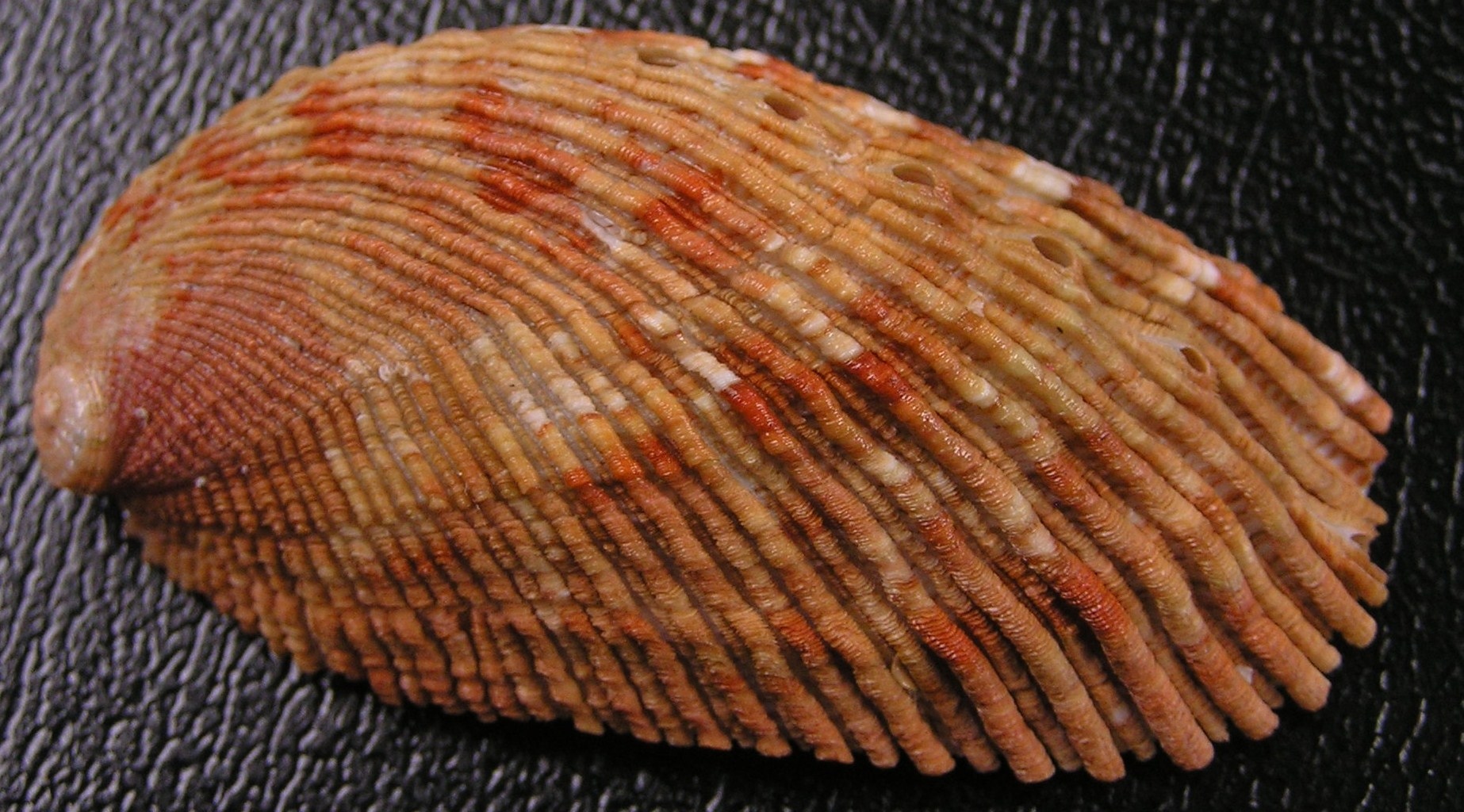
Elegant abalone
(Haliotis elegans)
Description
Haliotis elegans, common name the elegant abalone, is a species of sea snail, a marine gastropod mollusk in the family Haliotidae, the abalones. The size of the shell varies between 70 mm and 100 mm. "The elongated shell is rather narrow, subtruncate at its base, spirally densely and deeply sulcate. Its color pattern is ferruginous-buff, marbled and flamed with red. The inner surface is lightly grooved and brilliantly pearly. The spire is very short. This beautiful and rare mollusk is distinguished as well by its long drawn out form as by the shining nacre, which shows furrows corresponding to the ribs of the outer surface. The outer surface is closely and deeply furrowed by rough, prominent spiral ribs. These are closely scaly, and often between two thicker ones there is a weaker lower riblet. A few folds in the direction of growth striae make the surface still rougher, and are also visible on the inside. The color is a dirty yellowish-brown, flamed and marbled with reddish-brown, especially in young individuals." H. elegans is endemic to the waters off Western Australia. Haliotis, common name abalone, is the only genus in the family Haliotidae. This genus once contained six subgenera. These subgenera have become alternate representations of Haliotis. The genus consists of small to very large, edible, herbivorous sea snails, marine gastropod molluscs. The number of species recognized worldwide ranges between 30 and 130, with over 230 species-level taxa described. The most comprehensive treatment of the family considers 56 species valid, with 18 additional subspecies. Other common names are ear shells, sea ears, and, rarely, muttonfish or muttonshells in parts of Australia, ormer in the UK, perlemoen in South Africa, and the Maori name for three species in New Zealand is pāua. The shells of abalones have a low, open, spiral structure, and are characterized by having several open respiratory pores in a row near the shell's outer edge. The thick inner layer of the shell is composed of nacre, which in many species of abalone is highly iridescent, giving rise to a range of strong, changeable colors, which make the shells attractive to humans as decorative objects, in jewelry, and as a source of colorful mother-of-pearl. The shell of abalones is convex, rounded to oval shape, and may be highly arched or very flattened. The shell of the majority of species is ear-shaped, presenting a small, flat spire and two to three whorls.
Taxonomic tree: