Desert warthog
(Phacochoerus aethiopicus)
Description
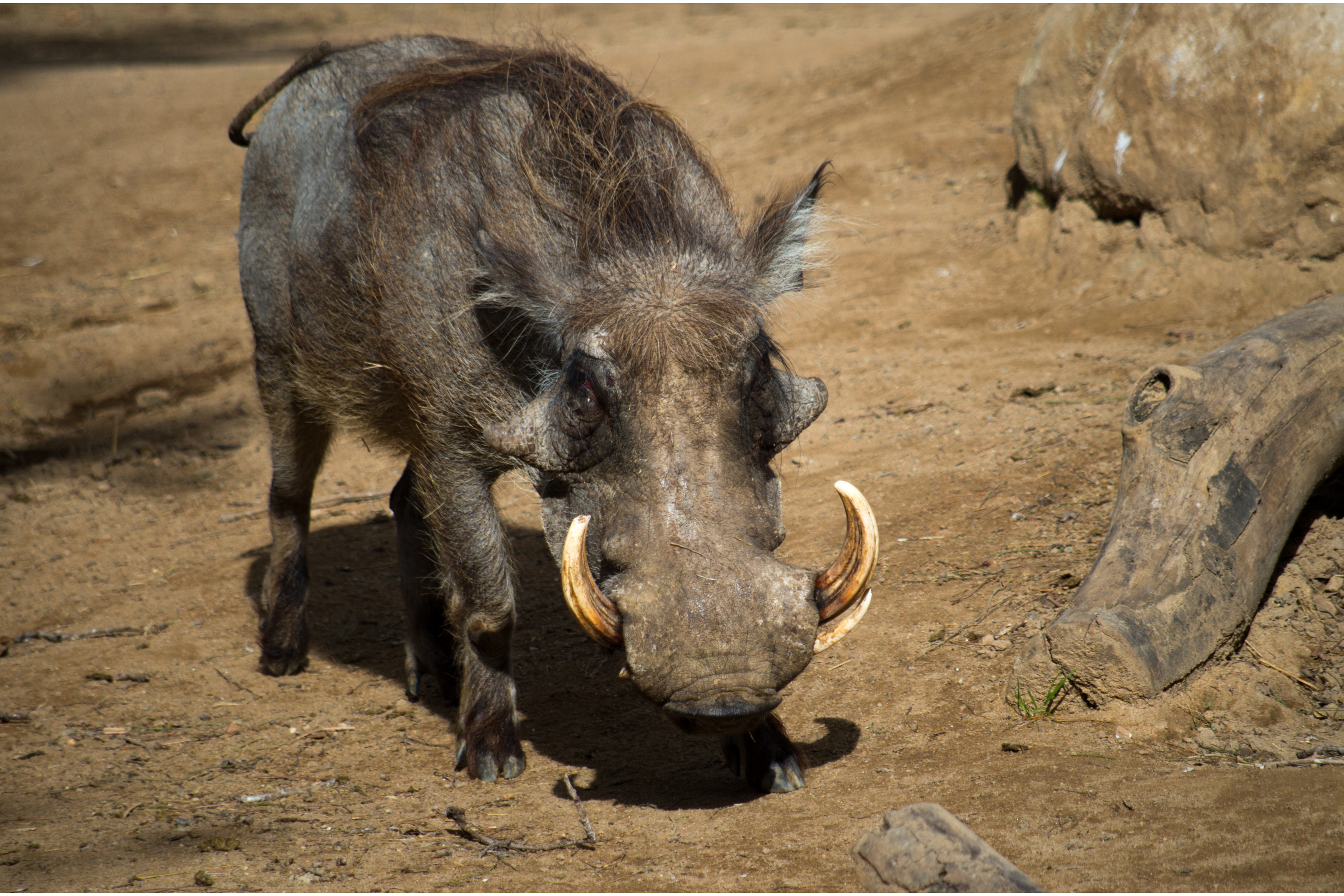
The desert warthog (Phacochoerus aethiopicus) is a species of even-toed ungulate in the pig family (Suidae), found in northern Kenya and Somalia, and possibly Djibouti, Eritrea, and Ethiopia. This is the range of the extant subspecies, commonly known as the Somali warthog (P. a. delamerei). Another subspecies, commonly known as the Cape warthog (P. a. aethiopicus), became extinct around 1865, but formerly occurred in South Africa. The desert warthog is a stockily-built animal growing to an average length of 125 centimetres (49 in) and weight of 75 kilograms (165 lb) with males being larger than females. It has a rather flattened head with distinctive facial paired protuberances ("warts") and large curving canine teeth that protrude as tusks. These are not present in juveniles but grow over the course of a few years. They are larger in males than in females. The body is sparsely covered with bristly hairs and a more dense region of hairs runs along the spine and forms a crest. The tail is long and thin and is tipped with a small brush of coarse hair. The general colour is mid to dark brown but the crest is sometimes whitish. The desert warthog differs from the bushpig (Potamochoerus porcus) and the giant forest hog (Hylochoerus meinertzhageni) in having facial warts and proportionately larger tusks. Desert warthogs can be differentiated from the common warthog by their distinctive facial features, including curled back tips at the end of the ears, lack of incisors, and generally larger snout. The suborbital areas in desert warthogs are swollen in the form of pouches that often extend to the base of the genal warts; these same areas in common warthogs have no such pronounced swelling. The species also has more strongly hook-shaped "warts", a more egg-shaped head, thickened zygomatic arches, and enlarged sphenoidal pits.
Taxonomic tree: