Autograph Tree
(Clusia hilariana hilariana)
Description
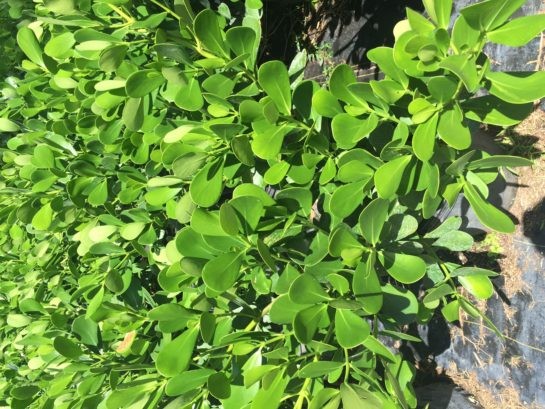
Clusia rosea, the autograph tree, copey, cupey, balsam apple, pitch-apple, and Scotch attorney, is a tropical and sub-tropical plant species in the genus Clusia. The name Clusia major is sometimes misapplied to this species. Clusia rosea is a tree native to the Caribbean, including the Bahamas, Hispaniola (such as in Los Haitises National Park), Cuba, Puerto Rico, and Florida. It is a hemiepiphyte, that is, it grows as an epiphyte on rocks or other trees at the start of its life and resembles a strangling fig (Ficus). Just as a strangling fig it overgrows and strangles its host tree with its many aerial roots. The petals are pink to white. The upper leaf tissue registers 'writing' giving it the common name autograph tree. The tree produces a fleshy, light green but poisonous fruit; once the fruit has split, the seeds are favored by birds and other wildlife. Clusia species are normally dioecious, but in C. rosea, there are pistillate individuals only, and seeds are formed through agamospermy. This plant is cultivated as an ornamental plant, for its flowers, foliage, and fruit. It is planted in gardens as a fruiting and ornamental tree in sub-tropical climates, and used as a houseplant in many climates. Clusia rosea has become a great threat to Sri Lanka, Hawaii, and many other tropical countries as an invasive plant. In Sri Lanka it is spreading rapidly on the mountains of the central hill country. It especially grows on rocks and rock outcrops where it forms dense thickets. Being a hemiepiphyte that resembles a strangling fig, it also sprouts on branches and trunks of native trees and rapidly overgrows and strangles them. It therefore poses a great threat to what little remains of the native submontane forests, and the unique native vegetation around rock outcrops, such as on the Hantana mountain range near Kandy. It is known as Gal Goraka or Gal Idda in Sinhalese.
Taxonomic tree: