Blue lotus
(Nymphaea maculata)
Description
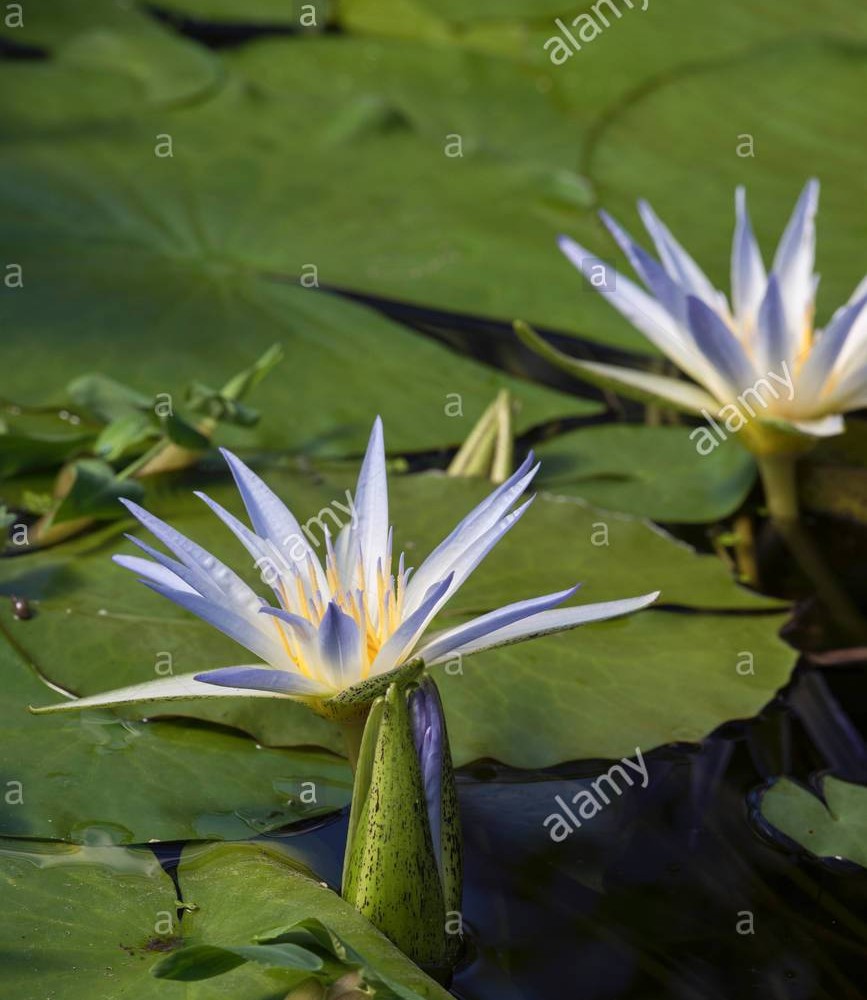
Nymphaea nouchali var. caerulea, also known as Nymphaea caerulea, and known in English as Egyptian lotus, blue lotus, blue water lily (RSA), Cape water lily (RSA), frog's pulpit (RSA), blue lotus of the Nile, blue waterlily, blue Egyptian lotus, blue Egyptian water lily (India), sacred blue lily of the Nile (India), Cape blue waterlily (USA) and sacred blue lily, is a water lily in the genus Nymphaea, a botanical variety of Nymphaea nouchali. It is an aquatic plant of freshwater lakes, pools and rivers, naturally found throughout most of the eastern half of Africa, as well as parts of southern Arabia, but has also been spread to other regions as an ornamental plant. It was grown by the Ancient Egyptian civilization, and had significance in their religion. It can tolerate the roots being in anoxic mud in nutritionally poor conditions, and can become a dominant plant in deeper water in such habitats. It is associated with a species of snail, which is one of the main hosts of the pathogen causing human schistosomiasis. The underwater rhizomes are edible. Like other species in the genus, the plant contains the psychoactive alkaloid aporphine(not to be confused with apomorphine – however aporphine is converted to apomorphine once metabolized).
Taxonomic tree: