Dipodium scandens
(Dipodium scandens)
Description
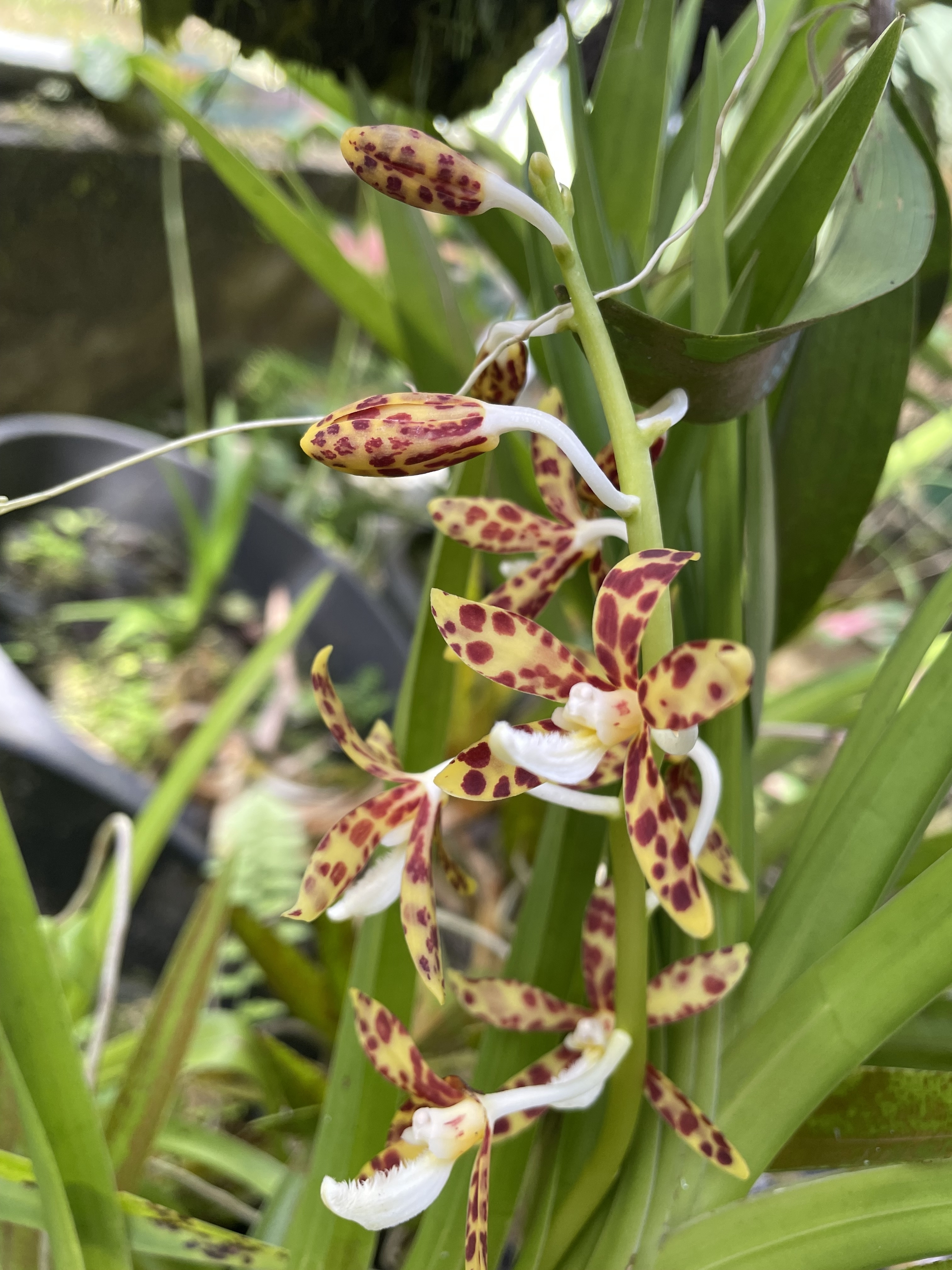
Dipodium scandens is an orchid species that is native to Malesia. The species was formally described in 1849 by German-Dutch botanist Carl Ludwig Blume who gave it the name Leopardanthus scandens. It was given its current name by Dutch botanist Johannes Jacobus Smith in 1905. Dipodium pandanum is recorded as a synonym of Dipodium scandens by the World Checklist of Selected Plant Families. However it is treated as a synonym of Dipodium pictum in the Australian Plant Census. The World Checklist of Selected Plant Families lists the distribution of this species as Borneo, Java, the Philippines, Sulawesi, New Guinea, the Bismark Archipelago, the Solomon Islands and Queensland. In Australia, the Queensland population originally classified under Dipodium pandanum is currently referred to Dipodium pictum according to the Australian Plant Census. Dipodium, commonly known as hyacinth orchids, is a genus of about forty species of orchids native to tropical, subtropical and temperate regions of south-east Asia, New Guinea, the Pacific Islands and Australia. It includes both terrestrial and climbing species, some with leaves and some leafless, but all with large, often colourful flowers on tall flowering stems. It is the only genus of its alliance, Dipodium. Orchids in the genus Dipodium are perennial, terrestrial herbs or climbers/epiphytes. Many species, particularly in eastern Australia are leafless mycoheterotrophs. Others have medium-sized to very large leaves that are parallel-veined and have entire margins. The flowers are arranged in a raceme with very few or up to fifty large, often colourful flowers. These may be fragrant or odourless, are white, pink, purple, yellow or green, often with spots or blotches. The sepals and petals are free from and similar to each other. The labellum projects forwards and has three lobes with a central band of colourful hairs. Each flower has two pollinia that are supported on two stipes. Dehiscent capsules, produced after flowering, hold the seed which is released when the capsule splits longitudinally along six seams. Between 30 and 500 seeds are produced per capsule The genus was formally described in 1810 by Scottish botanist Robert Brown in Prodromus Florae Novae Hollandiae et Insulae Van Diemen.The name Dipodium is derived the Greek words di (two) and podia (little feet), a reference to the two stipes supporting the pollinia
Taxonomic tree: