Navasota ladies' tresses
(Spiranthes parksii)
Description
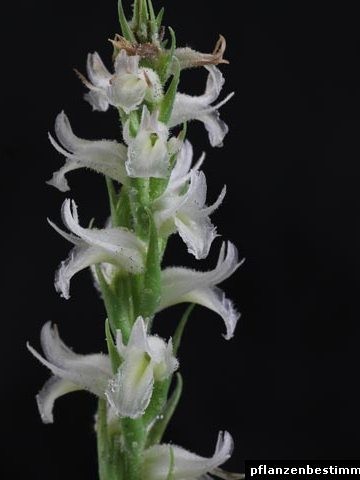
Spiranthes parksii, the Navasota ladies' tresses, is a species of orchid that is endemic to Texas, United States. The flower was first discovered in 1945 and was first described by Donovan Stewart Correll in his 1950 book, Native Orchids of North America North of Mexico. Spiranthes parksii is a slender-stemmed perennial, 8–15 inches (200–380 mm) tall. Leaves are long and thin and found mostly near the ground level, but usually disappear when the flower buds. Flowers petals are round or oval and off-white in color. The flowers typically spiral up the stem. Conspicuously white-tipped bracts occur underneath each 1⁄4-inch-long (6.4 mm) flower. The side petals have a green central stripe, and the lip (bottom petal) is distinctly ragged. Navasota ladies' tresses is primarily found in the East Central Texas forests, usually along creeks in the Brazos and Navasota River watersheds. In 1982, when the species was listed as endangered, only two populations were believed to exist, both in Brazos County. Since then, biologists have identified the species in Bastrop, Burleson, Fayette, Freestone, Grimes, Jasper, Leon, Madison, Milam, Robertson, and Washington Counties. The population in Jasper County is disjunct and the only one that occurs in the Piney Woods. Spiranthes is a genus of orchids in the subfamily Orchidoideae. They are known commonly as ladies tresses, ladies'-tresses, or lady's tresses. The genus is distributed in the Americas, Eurasia, and Australia. The genus name Spiranthes is derived from the Greek speira ("coil") and anthos ("flower"), and was inspired by the spirally arranged inflorescence. These are perennial herbs growing from fleshy root systems that range from slender to tuberous, and are occasionally stoloniferous. Most of the leaves are basal, but some species have leaves higher on the stem before the inflorescence matures, often taking the form of a sheath around the stem. The inflorescence is a terminal spike with flowers arranged in a characteristic loose or dense spiral. As in most other orchids, the flowers are resupinate, twisting during development into an upside-down position. The six tepals may be separate, or the three upper may be joined to form a hood over the lip petal. The lip is thin to somewhat fleshy, and two basal glands produce nectar. The flowers are usually white, cream, ivory, or yellowish, and two species have pink flowers; a few are also fragrant.
Taxonomic tree: